Key ideas along the journey
Immersing into an unknown landscape
Finding ways for orienting
Surrendering that there is no return
Discovering that the elsewhere you find yourself in, is Home
Whitout maps
Moshè highlighted the importance of limits and constraints in designing his classes and encouraged his students to learn to do less. When Franco was 19 years old, decided to put a limit in the way he was used doing his explorations and go in the wild without maps for heightening his sensitivity and sense of responsibility and safety. This way of doing enabled him to shape a mental map of the place. In a similar fashion Moshè talks about a mental self image that needs to be shaped through an anatomy from the inside.
Words from Franco Michieli, La vocazione di perdersi
Going into nature without a map and having to wait on the move for a sign to orient us, reawakens our sensitivity to those parts of existence that reason cannot reach – page 27
It is a limit (not using maps) which, like any other, encourages us to have intuition for what is not obvious, imagine the invisible and test out ways without knowing if they lead where we want, proceeding by trial and error: it makes us explorers – page 33
You don’t keep your course thanks to fixed but mobile references: the currents, the winds, the stars – page 49
Yet the world was large, and devoid of us – page 17
Words from Moshè
“You don’t need to make it happen but clarify the image so that you can release the holding that keeps the movement from happening”
“Cultivate the image in spite of the sensations”
Whiteout
Moshè wanted everyone to lie on the floor possibly with eyes closed to open oneself to an inner landscape while doing his lessons. Franco wants to immerse himself in the landscape rather than looking at it from above. It seems unbelievable that for him a whiteout is the best condition to start exploring.
Words from Franco Michieli, La vocazione di perdersi
It’s the fog that allowed me to see – page 63
I think whoever was following thought I knew the way, or that the track was still visible, but that wasn’t the case. This visual experience inside the ‘whiteout’ (where snow and fog merge and create an impenetrable whiteness) has happened to me on numerous subsequent occasions. It’s neither magic nor a miracle: it’s part of the range of possible experiences and this is what makes you reflect. (…) It was something like starting, at nineteen, to take away the role of the protagonist from myself, to see it increasingly widespread around me, in what is other than me – page 58
No return
One key notion by Moshè is reversibility. This is the capacity of changing direction while we move at any time without additional effort which is the way he understood a good posture. Franco says that he enjoys being in the wild for extensive periods of time and losing himself in that dimension without having a precise deadline and needing to come back. In a sense the movement he looks for is a “no return or no way back” movement. This idea seems to be in contradiction with Moshè’s idea of reversìbility. Or on the contrary it might help to understand it deeper.
Words from Franco Michieli, La vocazione di perdersi
Will we be able to protect the freedom to do without the irritation of Ariadne’s threads, those that prevent men from discovering whether the labyrinth of the world is made to get lost or to make us find ourselves invisibly on a path? – page 89
It’s difficult to return to the everyday life of our cities. After my first crossing of the Alps at 19, I never returned – minute 17 https://www.youtube.com/watch?v=hkbhwFSr6zU
Reflection on reversibility
Is reversibility a coming back?
Do you need to come back? The ariadne’s threads make you come back, do you need them? In a movement is there a coming back? Is thinking a movement in terms of back and forth that makes it more difficult the reversibility? If you let go of the threads (the instructions) would you maybe find the invisible path?
Losing oneself might inspire a different idea of movement
Franco says that he enjoys being in the wild for extensive periods of time and losing himself in that dimension. What he longs for is “permanence”. He needs to immerse himself in the landscape without having a precise deadline and needing to come back. In a sense the movement he looks for is a “no return or no way back” movement.
Feldenkrais talks about reversibility. In the Potent self he shows how reversibility results from acting spontaneously when there is a healthy unstable balance between sympathetic and parasympathetic. He also highlights that a spontaneous action does not involve hesitation because it is performed with a low emotional tone. This allows for a smooth reversing of the action.
When we reverse a movement in the sense of coming back, this generally involves a change in the emotional tone interrupting the smoothness of the movement itself (many times reflected in the holding of the breath).
The idea of “no way back” movement might help us to reconceive the notion of reversibility. Can we conceive of movement without a way back? This might suggest to explore a dimension where we could find an unstable balance within ourselves where changing direction at any moment might be possible without changing our inner emotional state (see here interesting Tao notion of deep sameness). This can be possible if we let go of the compulsion to achieve results and reach destinations. It is possible if we lose ourselves.
The question is, how not to come back?
Home
Moshè thinks of posture of a dynamic equilibrium where the person like a martial artist finds comfort on uncertain ground. Franco encourages us to recognize the unknown, the uncertain, the elsewhere, what in Italian he calls “altrove”, as home.
Words from Franco Michieli, La vocazione di perdersi
Imagining prehistoric humans (…) We could not be intimidated by the lack of such references, any more than the great prairie buffalo or the forest jaguar, which in the endless prairie and forest are simply at home. This is how we were, where today we would feel lost: in the immense house of the living, without walls and without roofs – page 21
The path reached us and never abandoned us again – page 45
A path that is not already traced takes shape without haste – page 46
Words from Moshè
If you don’t know where you are, wait.
Keep returning to the tanden
If you feel lost come back to the dantien
The attention on the tanden is more important than the movement. This means to distinguish if we are able to pay attention to do what we want or if something inside of us by itself does what it wants. In other words we are trying to stop being machine but rather to become something closer to being a human being that has awareness
Please see here about the “tanden”, https://www.waterdragonarts.com/en/blog/dantian
The Dan Tian is commonly known as the centre of gravity, Hara or Tanden (in Japanese), energy centre of the body or even the second brain. In internal martial arts it is one of the most important areas in the body. It is situated about 2 inches below your navel. Not just energy centre, but also called the wellspring of human energy. It is the residence of your original Qi. The Dan Tian is a neural network sometimes referred to as the 2nd brain.
The tanden is located in the lower belly. It asks to be felt and imagined. It needs us to become more sensitive. Feldenkrais highlighted its importance throughout all his life. The tanden is like home.
The Mother Dy
The mother wave or Moder Dy is a wave that experienced fishermen from Shetland are able to feel and listen when they are out at sea. This wave takes you always home.
A few very interesting references about the Moder Dy:
Moder Dy by Roseanne Watt
https://www.highlandbookprize.org.uk/archive/moder-dy-by-roseanne-watt/
‘The old Shetland fishermen still speak with something like reverence of the forgotten art of steering by the moder dy (mother wave), the name given to an underswell which it is said always travels in the direction of home
The mother wave by Jonathan Gourlay
https://themorningnews.org/article/the-mother-wave
The mother wave. When I first heard of it, it sounded like magic. A kind of knowledge that is not knowledge at all, just innate, ineffable knowing.
(…) the steady beat of the waves at night when you are sleeping on a small boat is like our mother’s heartbeat: the most basic, essential, deeply felt, mysterious marker of the way home.
(…) a haaf-man could feel the touch of the Moder Dy on the side of the boat, as good as a compass rose to a man who knows.
How can I speak of something that exists somewhere beyond language? Like the tug of currents or the sound of the beating heart of your mother as you curl unborn in the womb—it’s there, but elusive, indefinable.
there is a deep wave, an old song, a steady heartbeat that can guide you home.
Ian Napier, The Mother Dy: Steering by the waves in Shetland’s sea. In Northern Atlantic Islands and the sea, by Andrew Jennigs and others, page 15
https://pure.uhi.ac.uk/en/publications/the-moder-dy-steering-by-the-waves-in-shetlands-seas
“but the moder dy “flows straight with a long free sweep.” “We need no compass or light from the sky / … She makes for the land… / and will guide us safely home.”
References
Moder Dy by Roseanne Watt (Polygon)
‘The old Shetland fishermen still speak with something like reverence of the forgotten art of steering by the moder dy (mother wave), the name given to an underswell which it is said always travels in the direction of home
The mother wave by Jonathan Gourlay
The mother wave. When I first heard of it, it sounded like magic. A kind of knowledge that is not knowledge at all, just innate, ineffable knowing.
(…) the steady beat of the waves at night when you are sleeping on a small boat is like our mother’s heartbeat: the most basic, essential, deeply felt, mysterious marker of the way home.
(…) a haaf-man could feel the touch of the Moder Dy on the side of the boat, as good as a compass rose to a man who knows.
How can I speak of something that exists somewhere beyond language? Like the tug of currents or the sound of the beating heart of your mother as you curl unborn in the womb—it’s there, but elusive, indefinable.
there is a deep wave, an old song, a steady heartbeat that can guide you home.
Whitout maps
Moshè highlighted the importance of limits and constraints in designing his classes and encouraged his students to learn to do less. When Franco was 19 years old, decided to put a limit in the way he was used doing his explorations and go in the wild without maps for heightening his sensitivity and sense of responsibility and safety. This way of doing enabled him to shape a mental map of the place. In a similar fashion Moshè talks about a mental self image that needs to be shaped through an anatomy from the inside.
Whiteout
Moshè wanted everyone to lie on the floor possibly with eyes closed to open oneself to an inner landscape while doing his lessons. Franco wants to immerse himself in the landscape rather than looking at it from above. It seems unbelievable that for him a whiteout is the best condition to start exploring.
No return
One key notion by Moshè is reversibility. This is the capacity of changing direction while we move at any time without additional effort which is the way he understood a good posture. Franco says that he enjoys being in the wild for extensive periods of time and losing himself in that dimension without having a precise deadline and needing to come back. In a sense the movement he looks for is a “no return or no way back” movement. This idea seems to be in contradiction with Moshè’s idea of reversìbility. Or on the contrary it might help to understand it deeper.
Home
Moshè thinks of posture of a dynamic equilibrium where the person like a martial artist finds comfort on uncertain ground. Franco encourages us to recognize the unknown, the uncertain, the elsewhere, what in Italian he calls “altrove”, as home.
More in depth
Whitout maps
Moshè highlighted the importance of limits and constraints in designing his classes and encouraged his students to learn to do less. When Franco was 19 years old, decided to put a limit in the way he was used doing his explorations and go in the wild without maps for heightening his sensitivity and sense of responsibility and safety. This way of doing enabled him to shape a mental map of the place. In a similar fashion Moshè talks about a mental self image that needs to be shaped through an anatomy from the inside.
Words from Franco
Going into nature without a map and having to wait on the move for a sign to orient us, reawakens our sensitivity to those parts of existence that reason cannot reach.
Franco Michieli, La vocazione di perdersi, page 27
It is a limit (not using maps) which, like any other, encourages us to have intuition for what is not obvious, imagine the invisible and test out ways without knowing if they lead where we want, proceeding by trial and error: it makes us explorers.
Franco Michieli, La vocazione di perdersi, page 33
You don’t keep your course thanks to fixed but mobile references: the currents, the winds, the stars
Franco Michieli, La vocazione di perdersi, page 49
Yet the world was large, and devoid of us.
Franco Michieli, La vocazione di perdersi, page 17
Words from Moshè
“You don’t need to make it happen but clarify the image so that you can release the holding that keeps the movement from happening”
“Cultivate the image in spite of the sensations”
27 January 2025
Felden class
What is the shape of breath-hold the breath intentionally
Inspiration quote
“It’s the fog that allowed me to see”
Franco Michieli, La vocazione di perdersi, page 63
Notes
In this lesson Feldenkrais invited to become aware if we hold our breath and where/when we do that? It is about recognising a habit, become aware of it and possibly explore other ways of moving/breathing. This lesson is also meant to explore more generally the shape of the breath. Which is the form of breath? Which is its path? Back and forth? Like a wave? Circular?
Having the eyes closed during the class helps in listening and opening ourselves to a different perception. This linked with the above words by Franco.
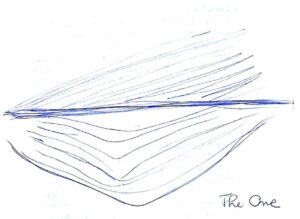
Drawing after class by student
20 January 2025
Felden class
On breath, diaphragm, vagus
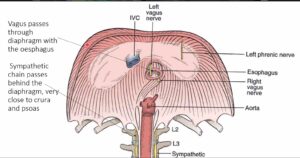
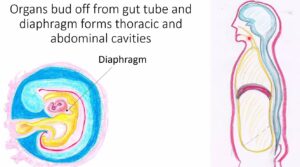
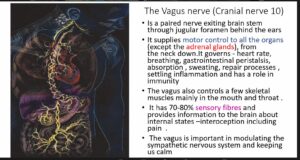
images from Unfolding Anatomy training – UK Feldenkrais Guild 2022
13 January 2025
Felden class
Wide gaze, converging diverging the eyes
Inspiration quote
“Today we walked a lot, but something had always been missing – a horizon – that’s what was missing.(…) . I acknowledge that it is longing, not only that for nature, or for something once possessed, but longing for what we have never had, and yet cannot help but miss.”
Franco Michieli, La vocazione di perdersi, page 79-80
Reflections and references
In this lesson Feldenkrais invited to find the wide gaze. In many of his classes he tried to help students to find a peripheral vision to balance the dominance of the focused way of looking. Peripheral and focused are not just ways of seeing but they affect the overall way of being in the world. Peripheral vision and the wide gaze make us feel more connected to the world and grounded.
This is highlighted in a book from neuroscientist Norman Doidge who dedicated a few chapters to Feldenkrais. Please find attached the one mentioning peripheral/focused vision and here a few lines from the book:
“He feels that the reliance of most sighted people on central vision—especially those of us who sit most of the day at a computer, focusing on a screen a few feet in front of us—at the expense of peripheral vision has a cost. Peripheral vision, which he relied on exclusively, gives the seer context. Central vision, with its focus on detail, can cause us to lose context. “Central vision,” he said, “is edges, lines, and details, but they are not in relationship with anything. The addiction to central vision leads us to a sense of nonconnectedness, and that is a fundamental problem.”
Norman Doidge, The brain’s way of healing, page 224
Here also notes on ‘soft eyes’ and observations by someone who is an Alexander Technique practitioner with Aikido experience.
“Do not look at your opponent’s sword, or you will be slain by his sword. Do not look into his eyes, or you will be drawn into his eyes. Do not look at him, or your spirit will be distracted.”
Morihei Uyeshiba – Founder of Aikido (“The Art of Peace”)
09 september 2024
Felden class
Moder Dy – The mother wave finding your way home
Inspiration quote
“Imagining prehistoric humans (…) We could not be intimidated by the lack of such references, any more than the great prairie buffalo or the forest jaguar, which in the endless prairie and forest are simply at home. This is how we were, where today we would feel lost: in the immense house of the living, without walls and without roofs.our way home”.
Franco Michieli, La vocazione di perdersi, page 21
Reflections
Last week after the class someone said that rather than feeling lost, they felt at home on the floor doing Feldenkrais. This is actually one of the central points in the exploration about losing oneself. Franco Michieli says to feel at home in the long walks he does and also when experiencing situations like a whiteout.
How can we find that way home?
A student mentioned the mother wave or Moder Dy, which is a wave that experienced fishermen from Shetland are able to feel and listen when they are out at sea. This wave takes you always home.
The class of today has been an attempt to sensitize us of a wave-movement that belongs deeply to each of us making us feel at home.
References
Moder Dy by Roseanne Watt (Polygon)
‘The old Shetland fishermen still speak with something like reverence of the forgotten art of steering by the moder dy (mother wave), the name given to an underswell which it is said always travels in the direction of home
The mother wave by Jonathan Gourlay
The mother wave. When I first heard of it, it sounded like magic. A kind of knowledge that is not knowledge at all, just innate, ineffable knowing.
(…) the steady beat of the waves at night when you are sleeping on a small boat is like our mother’s heartbeat: the most basic, essential, deeply felt, mysterious marker of the way home.
(…) a haaf-man could feel the touch of the Moder Dy on the side of the boat, as good as a compass rose to a man who knows.
How can I speak of something that exists somewhere beyond language? Like the tug of currents or the sound of the beating heart of your mother as you curl unborn in the womb—it’s there, but elusive, indefinable.
there is a deep wave, an old song, a steady heartbeat that can guide you home.
Notes
- doing circle and being caught by the circle idea. About language: following rather than leading a movement.
- serpentine movement. Not wanting to stand from the floor not because I feel tired but because I want to be in touch with this thread-beat-wave. There is a sound…
- about the darkness when palming the eyes. Deep blue in the end and the vastness of space.
- offered poems and haikus
02 september 2024
Felden class
Explore basic directions on the side to create and imagine a mental map
Inspiration quote
“The wintry isolation of the tundra introduces a further, nowadays more unusual concept: learning to “lose” yourself in domestic settings, such as where you live, is an equally interesting source of endless discoveries. In contrast to everyday life, this approach requires you not to rush back into the inhabited world but rather linger long enough to appreciate the vastness of the environment. What is needed is a thorough knowledge of physical and mental abilities, in our case adapted to arctic winter: wide experience had taught us how to read the landscape, snow, forests and sky to interpret the signs indicating the right route. It also helps to keep a ”mental map” of the region though this does not mean having memorised a geographical map but having understood, or occasionally just imagined particular features like water courses, valleys, high mountain chains, series of lakes, and so on, in such a way that they become useful references”.
Franco Michieli, La vocazione di perdersi, page 14-15
Notes
- During the class I don’t feel losing myself but actually feeling at home, finally on the floor, like in the womb.
- Interesting experiencing different landscapes when you change position of the body on the floor
26 August 2024
Felden class
Differentiating on the back
19 August 2024
Felden class
Hip joints connecting to chest
02 september 2024
Felden class
Explore basic directions on the side to create and imagine a mental map
Inspiration quote
“The wintry isolation of the tundra introduces a further, nowadays more unusual concept: learning to “lose” yourself in domestic settings, such as where you live, is an equally interesting source of endless discoveries. In contrast to everyday life, this approach requires you not to rush back into the inhabited world but rather linger long enough to appreciate the vastness of the environment. What is needed is a thorough knowledge of physical and mental abilities, in our case adapted to arctic winter: wide experience had taught us how to read the landscape, snow, forests and sky to interpret the signs indicating the right route. It also helps to keep a ”mental map” of the region though this does not mean having memorised a geographical map but having understood, or occasionally just imagined particular features like water courses, valleys, high mountain chains, series of lakes, and so on, in such a way that they become useful references”.
Franco Michieli, La vocazione di perdersi, page 14-15
Notes
- During the class I don’t feel losing myself but actually feeling at home, finally on the floor, like in the womb.
- Interesting experiencing different landscapes when you change position of the body on the floor
Inspiration quote
“The wintry isolation of the tundra introduces a further, nowadays more unusual concept: learning to “lose” yourself in domestic settings, such as where you live, is an equally interesting source of endless discoveries. In contrast to everyday life, this approach requires you not to rush back into the inhabited world but rather linger long enough to appreciate the vastness of the environment. What is needed is a thorough knowledge of physical and mental abilities, in our case adapted to arctic winter: wide experience had taught us how to read the landscape, snow, forests and sky to interpret the signs indicating the right route. It also helps to keep a ”mental map” of the region though this does not mean having memorised a geographical map but having understood, or occasionally just imagined particular features like water courses, valleys, high mountain chains, series of lakes, and so on, in such a way that they become useful references”.
Franco Michieli, La vocazione di perdersi, page 14-15
Notes
- During the class I don’t feel losing myself but actually feeling at home, finally on the floor, like in the womb.
- Interesting experiencing different landscapes when you change position of the body on the floor.